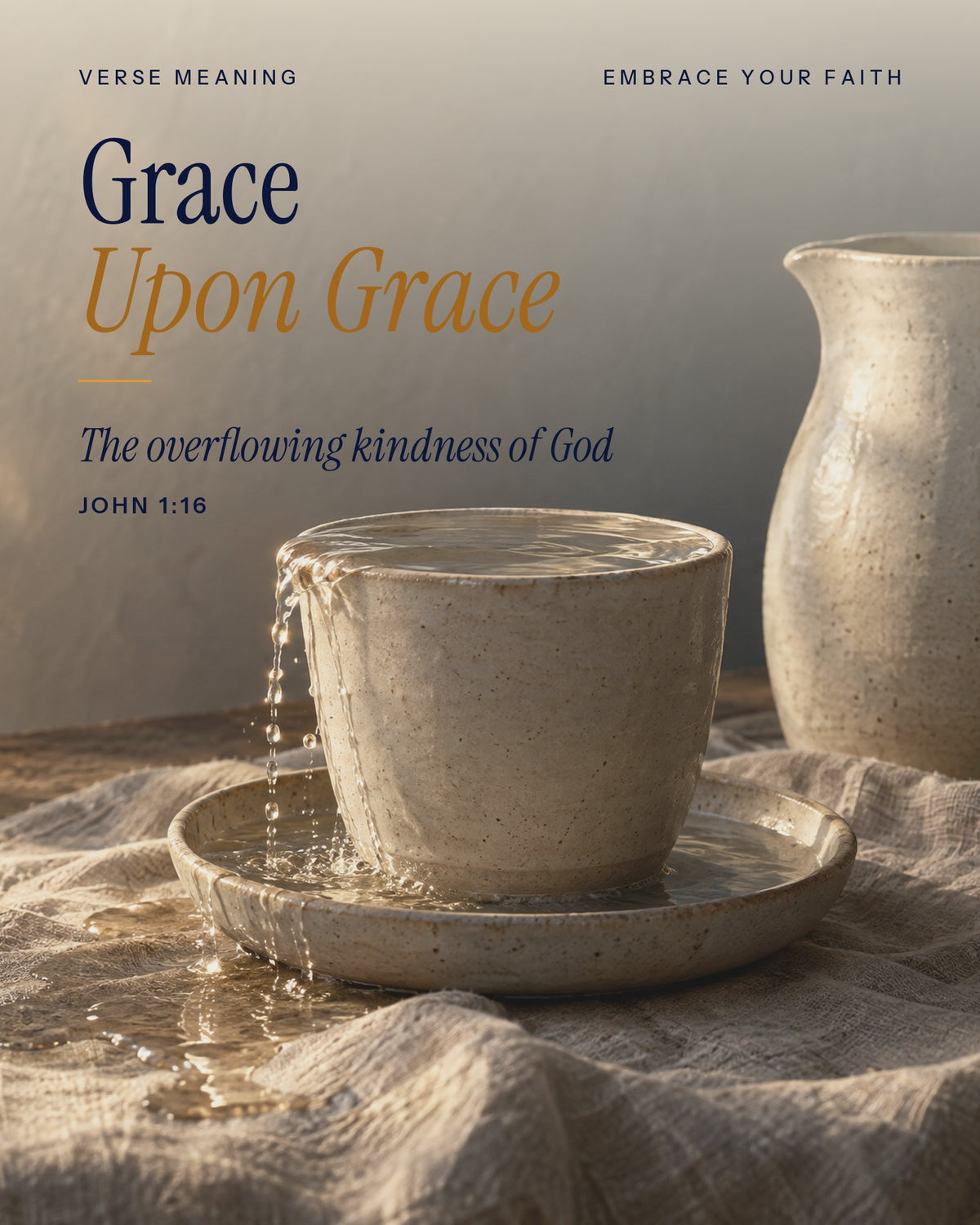
Grace Upon Grace: What John 1:16 Means
Summary: "Grace upon grace" comes from John 1:16, which the King James Version renders, "And of his fulness have all we received, and grace for grace." It means that believers receive an endless, overflowing supply of God's kindness through Jesus. One gift of grace is followed by another and another, like waves on a shore, because Christ is "full of grace and truth."
Scripture quotations in this guide are from the King James Version (KJV).
Some phrases in the Bible are so rich that they are hard to put into a single sentence. "Grace upon grace" is one of them. It is a short phrase that describes a lifetime of God's goodness. Many modern translations of John 1:16 use the words "grace upon grace," while the King James Version says "grace for grace." Both point to the same beautiful truth: in Jesus, God's grace never runs out.
In this guide, we will look at the verse in its setting, explain what the phrase means, and explore how you can live each day receiving grace upon grace.
What does John 1:16 say?
"And of his fulness have all we received, and grace for grace."
John 1:16
The verse has two parts. First, "of his fulness have all we received." Jesus is full, and we receive from that fullness. Second, "grace for grace." This phrase describes the way that grace keeps coming, one gift taking the place of another.
The Greek wording behind "grace for grace" can be translated literally as "grace in place of grace" or "grace instead of grace." That is why many modern versions render it "grace upon grace." The picture is of a continual supply. As soon as one portion of grace has done its work, another arrives. God never hands out His kindness in a single, limited dose.
Why does the KJV say "grace for grace" instead of "grace upon grace"?
The difference is one of translation, not meaning. The translators of the King James Version chose a word-for-word rendering of the Greek preposition, which gives "grace for grace." Later translators often chose wording that brings out the idea of one grace following another, which gives "grace upon grace."
Whichever wording you read, the message is the same. Believers receive grace that is renewed again and again. If you have seen "grace upon grace" on a card, a wall sign or a shirt, it is pointing to John 1:16.

What is the context of John 1:16?
John 1:16 sits inside the opening section of John's Gospel, often called the Prologue (John 1:1-18). These verses introduce Jesus as the eternal Word who was with God and was God, and who became a human being.
"And the Word was made flesh, and dwelt among us, (and we beheld his glory, the glory as of the only begotten of the Father,) full of grace and truth."
John 1:14
Notice the phrase "full of grace and truth." Two verses later, John says we have received "of his fulness." The fullness he means is this fullness of grace and truth that lives in Jesus. Because Jesus is full, those who come to Him are never left empty.
Then John adds a contrast:
"For the law was given by Moses, but grace and truth came by Jesus Christ."
John 1:17
John is not saying the law was bad. The law was a gift from God that showed His holiness and our need. But the law could not change a heart or pay for sin. In Jesus, God's grace and truth came in person. The grace that was hinted at and promised throughout the Old Testament became visible, touchable and personal in Christ.
What is grace in the Bible?
Grace is God's undeserved favor and kindness. It is God giving us what we could never earn: forgiveness, new life, His presence and His strength. Grace is not God lowering His standards. It is God meeting His own standards for us through Jesus.
"For by grace are ye saved through faith; and that not of yourselves: it is the gift of God:"
Ephesians 2:8
Grace is the starting point of the Christian life, but it is also the ongoing atmosphere of it. We are not saved by grace and then left to keep going on our own effort. We are saved by grace, kept by grace, and strengthened by grace every day. That is exactly what "grace upon grace" describes.
What does "grace upon grace" look like in real life?
The Bible describes many kinds of grace that God pours out on His people. Here are a few of the ways one grace follows another.
Saving grace
The first grace many people notice is the grace that brings them to Jesus. God draws us, forgives us and makes us His children. This is a gift no one can earn.
Sustaining grace
"And he said unto me, My grace is sufficient for thee: for my strength is made perfect in weakness. Most gladly therefore will I rather glory in my infirmities, that the power of Christ may rest upon me."
2 Corinthians 12:9
Paul begged God to remove a painful struggle. God did not remove it, but He gave Paul something better: grace that was enough. Sustaining grace is the strength to keep going when life is hard.
Daily, renewing grace
"It is of the LORD'S mercies that we are not consumed, because his compassions fail not. They are new every morning: great is thy faithfulness."
Lamentations 3:22-23
Yesterday's grace was for yesterday. Today's grace is fresh. God does not ask us to live on leftovers. Each morning brings a new supply.
Humbling grace
"But he giveth more grace. Wherefore he saith, God resisteth the proud, but giveth grace unto the humble."
James 4:6
"He giveth more grace." Those four words are a good summary of John 1:16. When we humble ourselves and admit our need, God gives more.
Abounding grace for good works
"And God is able to make all grace abound toward you; that ye, always having all sufficiency in all things, may abound to every good work:"
2 Corinthians 9:8
Grace is not only for our comfort. It overflows so that we can serve and bless others.
How do you receive grace upon grace every day?
Grace is a gift, so we do not earn it. But we can position ourselves to receive it with open hands. Here are simple ways to do that.
- Come honestly. Grace flows to the humble (James 4:6). Bring God your real needs, not a polished version of yourself.
- Pray boldly. "Let us therefore come boldly unto the throne of grace, that we may obtain mercy, and find grace to help in time of need" (Hebrews 4:16). The throne you approach is a throne of grace.
- Stay in the word. Scripture is one of the main ways God reminds us of His grace. A few verses each morning can reset your heart. Our guide on how to study the Bible offers a simple starting point.
- Receive grace through others. God often gives grace through the encouragement, prayers and help of other believers. Let people in.
- Give grace away. The more we receive, the more freely we can forgive, encourage and serve others. Grace flows best when it flows through us.
- Keep growing. "But grow in grace, and in the knowledge of our Lord and Saviour Jesus Christ" (2 Peter 3:18). Grace is not a single moment. It is a lifelong path of growth.
Is grace upon grace something we can earn?
No. If grace could be earned, it would stop being grace. Paul made this point plainly when he wrote that salvation is "not of works, lest any man should boast" (Ephesians 2:9). That truth applies not only to the day we first trust Christ but to every day after.
Many believers quietly slip into thinking that God's kindness depends on how well they performed this week. John 1:16 gently corrects that idea. We receive "of his fulness," not of our own. The supply comes from who Jesus is, not from who we have managed to be. That is why grace can keep coming even on the days we have little to offer. It also frees us to obey God out of gratitude rather than fear, because we are no longer trying to buy what He has already given.
Why does "grace upon grace" matter when you feel you have failed?
One of the hardest moments in the Christian life is when we have failed again. We may wonder if God's patience has finally run out. John 1:16 answers that fear. His grace does not run out, because it comes from His fullness, not from our track record.
This does not mean sin does not matter. Grace teaches us to turn away from sin and toward God. But it does mean that the door back to Him is always open. When you confess and return, you will find grace waiting, and then more grace after that.
If your heart is weighed down by regret, take time with our guide on why prayer matters, and bring your burden to the One who is full of grace and truth.
How can you keep "grace upon grace" in front of you?
Many believers find it helpful to keep reminders of God's grace close by. Some write John 1:16 on a card for their mirror or car. Others memorize it. Some wear it. Our Grace Upon Grace Graphic Unisex T-Shirt carries this phrase as a quiet, everyday reminder that God's kindness never runs dry, and it can open gentle conversations about the grace you have received.
A prayer for grace upon grace
Lord Jesus, You are full of grace and truth, and from Your fullness I have received grace upon grace. Thank You that Your kindness does not run out, and that Your mercies are new this morning. Where I am weak, let Your grace be sufficient. Where I am proud, humble me so I can receive more. Where I have failed, draw me back to You. Help me give the same grace to others that You keep giving to me. In Your name, amen.
Frequently asked questions
Where is "grace upon grace" in the Bible?
"Grace upon grace" is how many modern translations render John 1:16. The King James Version translates the same phrase as "grace for grace": "And of his fulness have all we received, and grace for grace."
What does "grace for grace" mean?
It means grace following grace in an endless supply. The Greek can be read as "grace in place of grace," picturing one gift of God's kindness replaced by another as each is received.
What is the "fulness" in John 1:16?
It refers to the fullness of Jesus, described in John 1:14 as "full of grace and truth." Believers receive from that fullness, which is why the supply never runs out.
Is grace only for salvation?
No. Grace saves us (Ephesians 2:8), but it also sustains us (2 Corinthians 12:9), renews us daily (Lamentations 3:22-23), humbles us (James 4:6) and equips us for good works (2 Corinthians 9:8).
How is John 1:17 connected to John 1:16?
John 1:17 explains the source of grace upon grace: "the law was given by Moses, but grace and truth came by Jesus Christ." The overflowing grace believers receive comes through Jesus Himself.