Where to Start Reading the Bible: A Simple Path for Beginners
Summary: Most people should start reading the Bible with the Gospel of John or Mark, because they introduce Jesus, the center of the whole Bible, in clear and short narratives. After a Gospel, read Acts, then a short letter such as Philippians or James, alongside a psalm a day. Once you know the story of Jesus, go back to Genesis and read the big story from the beginning, using a simple reading plan to keep you going.
Scripture quotations in this guide are from the King James Version (KJV).
The Bible is not one book. It is a library of sixty-six books, thirty-nine in the Old Testament and twenty-seven in the New, written over many centuries in history, poetry, law, prophecy and letters. Opening it at page one and reading straight through is a worthy goal, but many people who try stall somewhere in the middle of Leviticus and quietly give up.
There is a better way to begin. This guide shows you where to start reading the Bible, the order that helps most beginners, where to start depending on your situation and how to keep going once you have started. Once you have chosen your starting point, our guide on how to study the Bible shows you how to go deeper with any passage.
Where should a beginner start reading the Bible?
Start with Jesus. The whole Bible points to Him. After His resurrection, Jesus walked with two discouraged disciples and "beginning at Moses and all the prophets, he expounded unto them in all the scriptures the things concerning himself" (Luke 24:27). If Jesus is the key that unlocks the rest of Scripture, it makes sense to meet Him first.
The Gospel of John is the most common recommendation, and for good reason. John tells us exactly why he wrote: "But these are written, that ye might believe that Jesus is the Christ, the Son of God; and that believing ye might have life through his name" (John 20:31). It is personal, full of conversations and clear about who Jesus is.
If you prefer something shorter and faster, start with Mark. It is the shortest of the four Gospels, moves quickly from scene to scene and can be read in a couple of sittings.
What order should I read the Bible in as a beginner?
Here is a simple path that many new readers find helpful. It moves from the story of Jesus, to the early church, to practical teaching, and then back to the beginning.
- John or Mark. Meet Jesus: His teaching, miracles, death and resurrection.
- Acts. See how the first Christians spread the message of Jesus, picking up where the Gospels leave off.
- Philippians and James. Two short letters, one about joy and contentment in Christ, the other about living out your faith.
- Genesis. Go back to the beginning: creation, the fall and God's promises to Abraham.
- Exodus. God rescues His people from slavery and gives them His law.
- Luke. A second, fuller account of Jesus' life, now that you know the background.
- Romans. The clearest explanation of the gospel in the New Testament.
Alongside this path, read one psalm a day for prayer and one short section of Proverbs for wisdom. The Psalms will give you words for every season, from joy to grief.
Should I read the Bible from beginning to end?
Reading the whole Bible in order is a wonderful goal, and many believers do it every year or two. It is just not the easiest starting point. Some early books contain long genealogies, detailed laws and temple instructions that make much more sense once you know where the story is going.
A good approach is to read a Gospel and a few short books first, then come back and read from Genesis onward with a plan. You will recognize far more, because you already know the story ends with Jesus. As Paul says, "For whatsoever things were written aforetime were written for our learning, that we through patience and comfort of the scriptures might have hope" (Romans 15:4).
Where should I start reading the Bible for my situation?
If you are new to faith or exploring Christianity
Start with the Gospel of John, and read our guide on who Jesus is alongside it. If you want to take a first step of faith, how to know Jesus personally explains it simply.
If you are anxious or grieving
Start with the Psalms, especially Psalms 23, 27, 46 and 91, then read the Gospel of John. Our list of Bible verses for anxiety gathers some of the most comforting passages.
If you want practical wisdom for everyday life
Read a chapter of Proverbs each day (there are thirty-one, one for each day of a long month), then James.
If you want to understand the big story of the Bible
Read Genesis, Exodus, a Gospel and Acts, in that order. Together they give you the backbone of the whole story.
If you are reading with children
Start with the stories of Jesus in Mark or Luke, and read short passages aloud together. Family devotion cards such as Around the Table can help start conversations at mealtimes.
If it is Advent or Christmas
Begin with the birth of Jesus in Luke 1 and 2 and Matthew 1 and 2. Our free 25 Days of Christmas Advent reading plan walks you through it one day at a time.
How much of the Bible should I read each day?
Less than you think. One chapter a day, or even half a chapter read slowly, is a strong start. Fifteen minutes most days will shape you more than an ambitious plan that lasts a week. The goal is not to finish quickly but to meet God in His word. "Thy word is a lamp unto my feet, and a light unto my path" (Psalm 119:105). A lamp lights the next few steps, and that is often all we need.
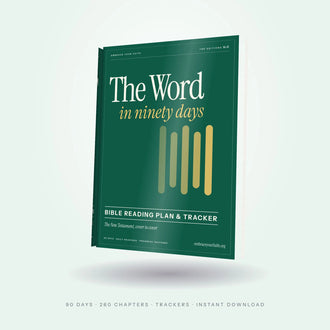
If you want structure, a reading plan removes the daily decision of what to read. The Word in Ninety Days takes you through the New Testament in about three chapters a day, with a tracker to mark your progress.
Which Bible translation should I start with?
Choose a translation you understand and will actually read. The King James Version is beautiful and widely memorized, and we use it throughout our guides. Some readers like to keep a modern translation beside it for clarity. Whatever you choose, the most important step is opening it.
How do I keep reading the Bible once I start?
- Pick a time and place. Same chair, same time, most days. Habits grow from routines.
- Use a simple method. The SOAP Bible study method gives you four headings to fill in each day.
- Write something down. One verse and one sentence of response helps you remember.
- Read with someone. A friend, spouse or small group keeps you encouraged and accountable.
- Pray as you read. Ask God to help you understand, and respond to what you read. Our guide to prayer can help.
- Do not quit after missed days. Simply pick up where you left off.
A prayer before you start reading
Lord, I want to know You through Your word. As I begin, help me understand what I read, and help me meet Jesus on every page. When I lose my way or miss a day, draw me back gently. Make Your word a lamp to my feet and a light to my path. In Jesus' name, Amen.
Frequently asked questions
What is the best book of the Bible to start with?
The Gospel of John is the most common recommendation, because it was written so that readers would believe in Jesus and have life in His name (John 20:31). Mark is a good alternative if you want something shorter.
Should I start reading the Bible at Genesis?
You can, but most beginners find it easier to start with a Gospel and then go back to Genesis. Knowing the story of Jesus first helps the Old Testament make more sense.
How long does it take to read the whole Bible?
The Bible has 1,189 chapters. Reading about three to four chapters a day takes you through it in roughly a year. Many reading plans are designed around that pace.
Is it okay to read the Bible out of order?
Yes. The Bible is a library of sixty-six books, and it is normal to read them in a helpful order rather than strictly front to back. Just read each book in context, from beginning to end, rather than jumping between random verses.
What if I do not understand what I am reading?
That is normal. Reread the passage, look at the verses around it, write your question down and ask a pastor or mature Christian friend. A study Bible with notes can also help.